
Blogging vs. Vlogging: Which Pays More?
Blogging vs Vlogging in 2025: Which One Really Pays More?

You’ve seen both sides.
- Bloggers sharing income reports with affiliate links and RPMs.
- Vloggers flashing sponsorships and AdSense checks.
But which one actually makes more money?
Let’s clear the fog. This isn’t a hype war – it’s a grounded look at how both models work, what creators can realistically earn, and where the smarter money lies in 2025.
First: How They Make Money (And What You Don’t See on Social)

Bloggers Monetize Through Systems
Top bloggers aren’t just writing and waiting. Their blogs are wired for income with:
- Affiliate links tied to product searches
- Display ads (Mediavine, Raptive) that generate passive revenue
- Digital products like templates, courses, or kits
- Email funnels that warm up traffic and drive sales
- Sponsored posts that target niche readers
And with tools like AI Content Aggregator and Auto Backlinks Builder, bloggers aren’t guessing – they’re mapping content clusters, internal linking strategies, and SEO angles that build long-term authority.
Vloggers Monetize Through Audience Velocity
YouTubers earn via:
- AdSense ($2–$12 per 1K views)
- Sponsorships ($250 to $5,000+ depending on reach)
- Affiliate links in descriptions
- Merch, memberships, and Patreon
- YouTube Premium view share (minimal)
But they’re at the mercy of:
- Platform rules
- Algorithm shifts
- Watch-time demands
- Daily performance pressure
Now: What the Income Math Actually Looks Like

For New Creators: 10K Visitors vs 10K Views
- Blogging: Even with modest traffic, you can earn $300–$800/month if your content is optimized.
- Vlogging: Unless your content is sponsor-heavy or in a high-CPM niche, you’re looking at $50–$150/month.
Verdict: Blogging wins early – especially with affiliate-heavy posts and a clean funnel.
For Growth Creators: 100K Blog Views vs 100K YouTube Views
- Blog with optimized content and email monetization: $3K–$10K+/month
- YouTube channel with strong retention and brand deals: $1.5K–$6K/month
Verdict: Blogging offers higher margins, more ownership, and fewer moving parts.
Time Investment and Burnout Risk
- Blogs can be scheduled, updated, and ranked for years.
- Vlogs need weekly uploads, editing, scripting, and platform reactivity.
One scales through systems.
The other scales with hustle.
Where It Gets Interesting: The Hybrid Model
Smart creators aren’t choosing either/or. They’re combining both:
- Start with a blog post built using AI Content Aggregator
- Repurpose it into a YouTube script
- Embed the video in your post
- Use both to feed your email list
It’s a cross-platform traffic flywheel – and it converts.
Final Word: Which Pays More in 2025?

If you want:
- Ownership
- Long-term ROI
- A system that works while you rest
→ Blogging wins.
If you love:
- On-camera energy
- Creative editing
- Platform momentum
→ Vlogging can thrive – but requires constant fuel.
But the biggest wins?
They belong to creators who build a content ecosystem – and automate it with tools like AI Content Aggregator.
FAQ – Blogging vs Vlogging Income Comparison
Q: Do bloggers make more money than vloggers?
A: Generally, yes – especially when factoring in ownership, affiliate income, and passive monetization through SEO. Bloggers control their platforms, build email lists, and earn through layered strategies. Vloggers can earn big but often rely heavily on platform performance and sponsorship cycles.
Q: What is the average revenue per 1,000 views for blogs vs YouTube?
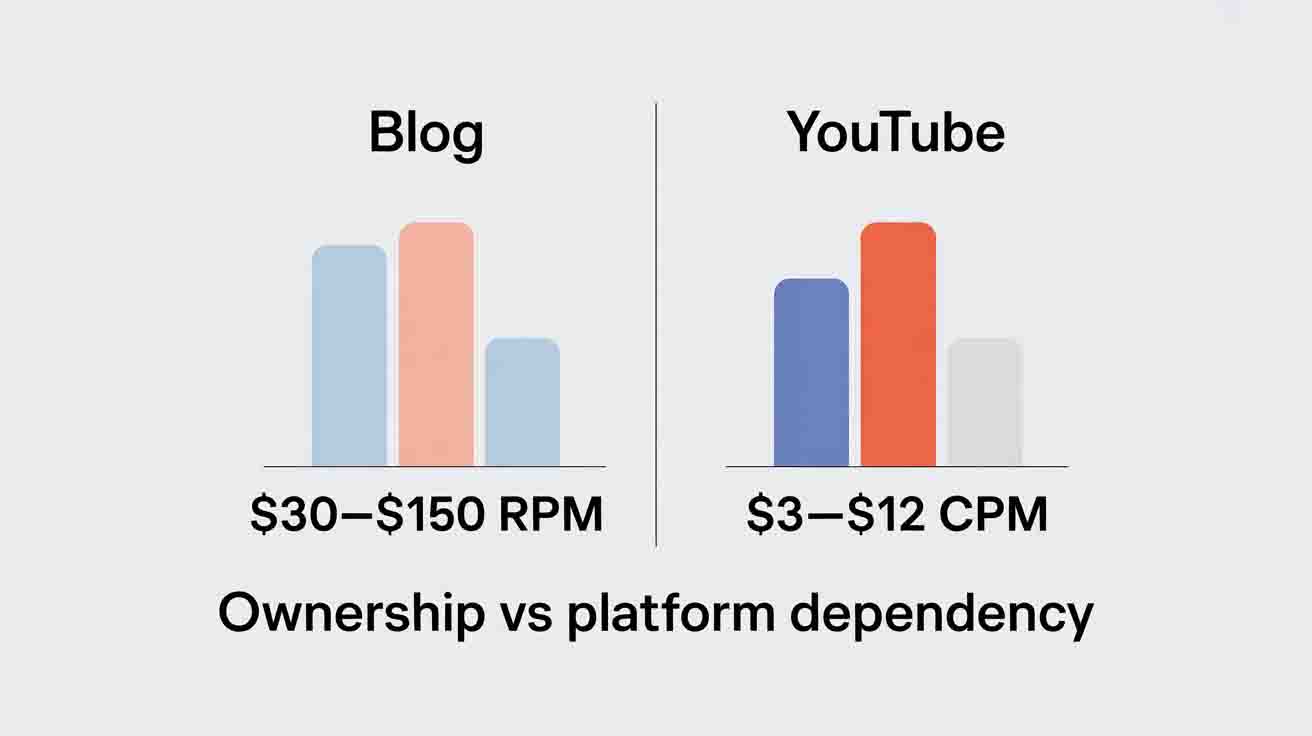
A: Blogs often earn $30–$150+ RPM (revenue per 1,000 visitors), depending on affiliate integration and niche. YouTube CPMs range from $3 to $12, sometimes higher in finance or tech. Blogging tends to have stronger ROI per visitor.
Q: Which takes more time – blogging or vlogging?
A: Vlogging usually requires more time due to filming, editing, and uploading. Blogging can be batch-created, scheduled, and managed with SEO tools like AI Content Aggregator, and Auto Backlinks Builderreducing the daily time load and increasing long-term leverage.
Q: Can you combine blogging and vlogging for better results?
A: Absolutely. Many top creators write long-form blog posts and repurpose them into YouTube videos. Embedding videos in blog posts also boosts engagement and SEO. With tools like AI Content Aggregator, and Auto Backlinks Builder it's easier to build structured, dual-format content.
Q: Is blogging still profitable in 2025?
A: Yes – more than ever. SEO has matured, ad networks have improved, and tools like AI Content Aggregator make it easier to create strategic, income-generating content. The key is planning around user intent and building systems – not just writing.
Both blogging and vlogging require proper FTC disclosure blogging practices when monetizing content through sponsorships or affiliate marketing.